

Scholars, practitioners tackle AI question
Updated: Jun 5
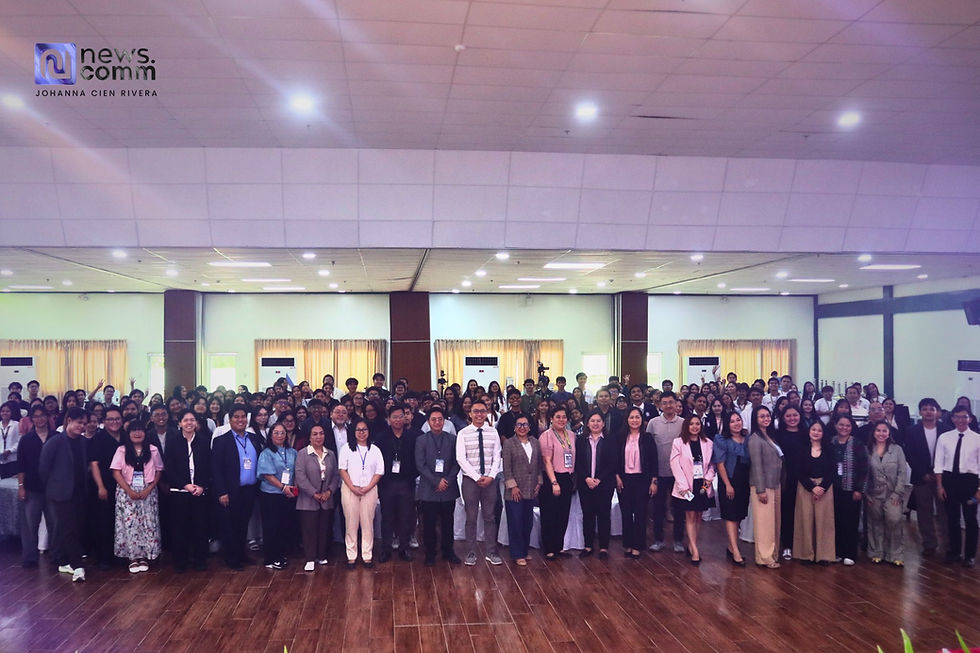
“Is artificial intelligence [AI] a troubleshooter or a troublemaker?” This was the question that communication scholars and practitioners problematized during the 4th FRAMEwork: Asia-Pacific Communication Conference last March 26 and 27 at the International Convention Center of Cavite State University (CvSU).
Dr. Andrew Prahl of Nanyang Technological University Singapore discussed how AI-driven systems are reshaping organizational systems, infrastructures, and research practices in Southeast Asia, while Dr. Ma. Rosel San Pascual of the University of the Philippines Diliman underscored the need for approaches that are responsive, responsible, and reflexive amid the rise of AI. Together, their keynote sessions located AI within two pressing concerns: institutional change and ethical scholarly responsibility.
Following the keynote sessions were special lectures and a roundtable discussion that examined AI’s role across industries and fields of practice. Sessions covered creative work, public relations, social and humanitarian initiatives, and the shifting conditions of communication labor. While AI enables data-driven decision-making, content generation, and audience engagement, speakers emphasized that human judgment, creativity, and ethical discernment remain central to communication work. The role of communicators, they said, is evolving toward adaptive, interdisciplinary skill-sets anchored in both technical competence and critical thinking.
“Let AI aid us, not replace us,” said Jamela Alindogan, FEU's outstanding communication alumna and former Al Jazeera English correspondent, and now Foreign Affairs Editor and Public Affairs Anchor of Bilyonaryo News Channel. She placed human expertise at the center of the discussion, especially in fields where presence, context, and discernment remain necessary. Dr. Joeven Castro, FEU Vice President for Student Development and Continuing Education, reinforced Alindogan’s point by noting that “communication schools must focus on curation and taste,” a reminder that the effective use of AI depends not only on access to tools, but on the ability to judge, select, refine, and contextualize.
The first day concluded with a roundtable discussion on the proliferation of misinformation, disinformation, and malinformation. Discussants and participants explored strategies including media literacy, institutional guidelines, and the use of AI itself as a tool for verification and resistance against online deception. A networking session encouraged collaboration among participants and partner institutions, creating a venue where communication schools, practitioners, and researchers build continuing relationships.
Dr. Augustus Ceasar Latosa, co-convener of the conference and faculty member of the FEU Department of Communication, opened the second day with a synthesis of the previous discussions. His recap situated AI as a technological development, as well as a continuing challenge to communication systems, pedagogies, and professional judgment.
The series of AI-related conversations continued with the plenary talk of Dr. Alvin William Alvarez of CvSU who said AI was “definitely not a troublemaker” especially in the context of scientific discourse. However, he drew attention to accuracy, reliability, misuse, and human verification. Dr. Changsong Wang of Xiamen University Malaysia examined in his plenary session how AI was changing creative workflows in filmmaking. The discussion placed attention on storytelling, production practice, and the changing relationship between human imagination and machine-assisted tools.
To cap the second day, Dr. Marco Polo of De La Salle University Dasmariñas explored how AI and emerging technologies may enhance classroom engagement and support learning outcomes. He reminded educators that tools must remain anchored on pedagogy.
Parallel sessions across both days featured a wide range of research presentations examining AI in such areas as digital marketing, education, journalism, governance, and community communication. These sessions provided a platform for emerging and established scholars to present empirical studies and theoretical reflections, fostering dialogue on how AI is shaping communication landscapes at multiple levels.
“For our 5th FRAMEwork Conference, we hope to explore crisis communication, a theme that feels urgent in a time marked by global chaos, instability, and uncertainty,” said Dr. Rowena Capulong-Reyes, FEU Vice-President for Corporate Affairs, in her closing remarks. “Communication matters most when conditions are difficult. It helps institutions, communities, and publics find clarity, trust, and direction.” Capulong-Reyes, also the lead convener of FRAMEwork, thanked the organizers, guests, volunteers, participants, and partner institutions that sustained the two-day gathering.
Organized by FEU and hosted by the College of Arts and Sciences, Department of Communication of Cavite State University, the conference marked an important milestone as FRAMEwork held its first edition outside FEU. This expansion signaled the platform’s growing reach as a scholarly and professional space for communication scholarship and education in Asia-Pacific Region.

The conference was held in collaboration with a wide network of academic and professional partners. Local partners included the Asian Institute of Journalism and Communication, National University Dasmariñas, University of the Philippines Diliman, University of the Philippines Mindanao, University of Science and Technology of Southern Philippines, Visayas State University, the Asian Network for Public Opinion Research, the Philippine Association of Communication Educators, and the Polytechnic University of the Philippines PhD Communication Society.
International partners included Amity University Haryana, Atma Jaya Catholic University of Indonesia, and the University of the Thai Chamber of Commerce.
The theme was deliberately framed as a provocation as AI is no longer a distant technology to be observed from the margins. It is shaping how messages are produced, how publics are studied, how stories are told, how campaigns are designed, and how classrooms are managed.
Across two days, FRAMEwork brought together 268 attendees on Day 1 and 272 on Day 2, including organizers, presenters, students, and guests across the Philippines and the Asia-Pacific Region, reflecting sustained engagement as well as strong national and international participation.
To know more about the Bachelor of Science in Communication program, please visit this link: https://www.feu.edu.ph/institute-of-arts-and-sciences/ba-comm/


Comments