

Continuing a tradition: Faculty wins national book award
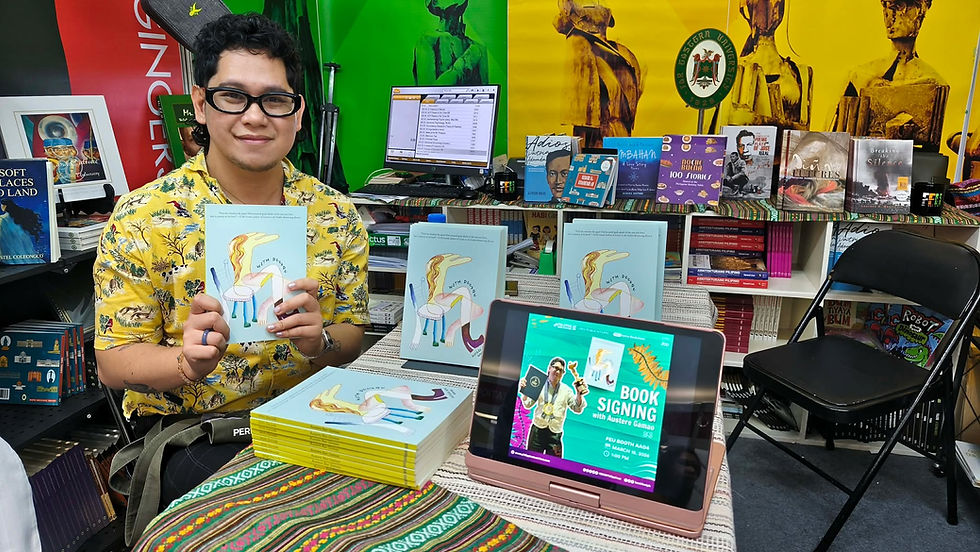
An award-winning collection that centers a queer, genderfluid voice navigating the mundane has earned Far Eastern University its latest national recognition in literature.

Austere Rex Gamao, a faculty member of FEU’s Department of Language and Literature, won the Philippine Literary Arts Council Prize for Best Book of Poetry in English at the 43rd National Book Awards last Feb. 13, for his debut collection, With Decade. The recognition, one of the most prestigious in Philippine literature, caps years of persistent work, and, Gamao is careful to note, decades of rejection.
“I failed so many times. With Decade has failed so many times,” he said. “I’ve entered contests. I’ve submitted in journals, in writing workshops. My acceptance rate isn’t very high. But I did not let it stop me. Of course it hurts. Rejections always, always, always hurt. But from the first rejection to the 50th rejection, I understood that it’s really part of the process. It’s not something that you should be ashamed of.”
Gamao joined FEU in 2023 after years in the corporate sector, a transition he describes as transformative. Teaching, he said, gave him something that office work was not able to. “When you’re in corporate, you’re just sitting there, just limited to your cubicle and that world, that particular industry that you’re working in. With teaching, you get to expand your horizons.” He teaches general education alongside creative process and literature courses.
“I think writing and teaching go hand in hand. Because if you’re not interested in writing or reading, then it will be really, really difficult for you to teach. And if you don’t know how to teach reading and writing, it’s going to be so difficult for students to appreciate reading, or understand why it’s necessary.” Teaching also pushed him to become a more rigorous writer. He credits the creative research that classroom work demands, and the emphasis on clarity and intentionality it cultivates, as deepening his craft as a poet. Having gone through mentorship as a master’s student, he now mentors thesis students of his own. “Now I’m on the other side,” he said. “Now I’m the one mentoring.”
With Decade, which began as his master’s thesis, is structured as a novel in verse. It follows a queer, genderfluid character through daily life rather than the sweeping conquests typical of the epic tradition. Gamao said the choice was deliberate. “There are characteristics of what epic poetry is: featuring usually male characters, and there are two kinds of stories — one is about finding wives, two, they have to conquer lands. And I didn’t resonate with that. I wasn’t interested in grand narratives,” he said.
The collection is also unapologetically queer. “It’s queer because I am queer. I wanted to write about someone who’s stranger than I am.” Its influences range from Anne Carson’s Autobiography of Red and CAConrad’s The Book of Frank to a dance production of the epic Hinilawod he saw as an undergraduate student. Gamao was drawn to the idea of poems that spill into each other— characters and settings that persist and accumulate across a book rather than dissolving after a single page. “I really wanted to play around with the form. The book is really about playing with meaning, playing with what a poetry book can do, especially if there’s a setting and characters, a loose narrative.”
Humor, in fact, was central to the project. “I really wanted to be funny. I hope you laugh, I hope it’s strange and funny because I didn’t want to be so self-serious. Because whenever we talk about poetry, it’s always like ‘I’m sad’ or ‘I’m in pain.’” He does not dismiss that tradition and understands the cathartic weight of poetry about pain, but With Decade sets out to show what the form can do when it allows itself to be irreverent, even comic. Intentionality, a lesson hammered home by his mentors. “How to make a concept shine more and how to push it a little more so that you get something newer, something fresher,” he said, describing what that mentorship taught him.
The award, Gamao insists, is not primarily his to keep. He dedicated the recognition to his family, who supported his writing from an early age despite limited means. His mother would bring home books from Scholastic fairs whenever she traveled to Manila or Baguio for seminars — books worth P10 apiece, bought in abundance because she recognized her son’s talent and chose to nurture it. His father collected loose sheets of paper for him to draw on. His older sister helped put him through college. “The award is for all of their sacrifices,” he said. “They’ve done so much for me. It’s really for them.”
He also dedicated the win to Sagay City, where he grew up. In his acceptance speech, Gamao expressed hope for more creative opportunities for children in the regions, particularly those drawn to writing and the arts. “I hope that kids back home, in my hometown, would be inspired to write, and to draw, and to be in the arts. There’s a lot of artistic and creative people in Sagay City, and we just need the budget and support from the government.”
Despite the recognition, Gamao has no interest in positioning himself as a gatekeeper of the form. “I really don’t want it to get to my head. I don’t want to be a spokesperson for poetry. I don’t want to gatekeep anything—this is the only poetry that is correct, this is acceptable.” What he hopes the award does, instead, is draw readers toward more Filipino literature. “I hope that the book will also lead them to other books because there are so many, many talented Filipino writers.”
That concern, about who is reading, and whether anyone is, runs through much of how Gamao speaks about the state of Philippine literature. He is frank about what he sees as a crisis in reading and writing, one he believes has been accelerated by the shift toward short-form visual media. “Because of TikTok, social media—everything became visual and oral, literacy became compromised. We’re coming back to orality now. Some of us have lost appreciation for the written word, how it works.” He elaborates on what gets lost when reading is replaced by passive consumption. “Reading is not a passive act. You get to practice your empathy. You get to practice your imagination. You get to practice your thinking. If you’re just watching a video on TikTok, it’s easier. It’s a passive way of consuming something.”
Literature depends on new voices willing to carry it forward, but those voices must first be readers. “You can’t just say ‘I’m a writer’ and not read. You have to read. You have to read the people that were there before you because that’s how you continue.” Acknowledging one’s literary predecessors, even the complicated or flawed ones, is, for Gamao, both ethical and practical. “We should always remember the people that came before us, even if they’re problematic, even if you don’t really like them—they’ve paved the path.”
For FEU students drawn to writing, his message is direct: “do not give up, and do not wait to be comfortable before you begin. I struggled my way through it. This dream did not come easy at all. All my life I’ve struggled—struggled to eat, jumped from job to job, struggled through heartbreak, struggled through a lot of crises. But I kept holding on to that dream. There’s something in me that kept fighting.”
His hopes for FEU’s literary community are also institutional. Gamao sees the FEU as sitting atop a wealth of literary history. He cited figures including José Garcia Villa, Maningning Miclat, Alejandro Roces, Gemino Abad, and Lourdes Montinola as part of a tradition that deserves renewed attention. “We have such a rich literary history, but it’s being forgotten, and that is one of my missions—to bring that back.”
He is already at work on a second collection, a slower project he has been developing since 2023. The National Book Award, he said, is not a signal to pause. “The message for me with this award is, this will not be the end. I won’t stop writing because it has been my dream for a very long time. Since I was grade two, I really pursued it doggedly.”


Comments