

The work behind the design

When Joaquin Luis C. Hilario and his groupmates presented Common Ground Studtion, they were not pitching an actual architectural firm to paying clients. They were presenting a concept they had built from scratch: its name, identity, design philosophy, and reasons a client might choose them over another firm.
Still, standing in front of a panel of practicing architects brought a little of the pressure of professional life into the classroom. Their group was assigned to present first, and Hilario admitted that they were nervous about how their ideas would be received.
The experience was part of the TamFLEX Series, a three-session program that gave Far Eastern University Institute of Architecture and Fine Arts (FEU-IARFA) students a look at what happens beyond designing buildings. Through industry discussions, an office visit, and the final firm presentation, students encountered the parts of architectural practice that drawings and models alone cannot teach.
For Hilario, one of the biggest realizations was that being an architect involves much more than producing a good design. It also means knowing how to work with people, explain decisions, handle responsibilities, and build relationships that may lead to opportunities.
After the design
Before joining TamFLEX, Hilario pictured architects spending much of their time designing buildings, preparing drawings, and completing assigned tasks. The series gave him a broader view of what professional practice actually involves.
TamFLEX stands for FEUture-Ready Learning and Employability eXperiences. It was organized in partnership with Headroom CDV Co. to help students connect what they learn in school with the expectations of the industry.
It began last Sept. 8 with an online session via Microsoft Teams titled “Back of the Head: A Primer on the Actual Architectural Practice.” Architects discussed matters such as contracts, project documentation, professional standards, and communicating with clients.
One subject particularly caught Hilario's attention: how a firm builds its client base.
He was curious about how Headroom secured projects with established companies, including The Bistro Group, so he asked the speakers about it. Their answer gave him a glimpse of how professional relationships can shape a firm's growth.
Photo Credits: FEU Career Development and Placement Facebook Page
The architects said their practice started as a small firm in 2014, taking on relatively small projects before earning further opportunities through referrals and connections with clients, contractors, and other professionals.
For Hilario, this challenged the idea that a strong portfolio and design ability would be enough to establish a career.
“The insight that resonated with me the most was when they said you never really know when or where you will meet a potential client,” he said.
It is advice that applies even while he is still a student. A conversation with a future colleague, a connection made during an internship, or a presentation to a potential collaborator could eventually open a door. Being prepared means developing one's work and learning how to present it professionally before those opportunities arrive.
The session also touched on a less glamorous but necessary part of practice: contracts.
Hilario had previously found contracts intimidating because of their legal terms and technical language. Through the discussion, he began to understand their purpose in defining fees, deliverables, and the limits of an architect's responsibilities.
He connected this lesson to pakikisama, a Filipino value that helps people maintain harmonious relationships but can sometimes make setting boundaries uncomfortable.
For him, being professional also means knowing what has been agreed upon and communicating those expectations clearly. It is a practical consideration that can be easy to overlook when students are focused on the creative side of architecture.
Workplace more than workstation
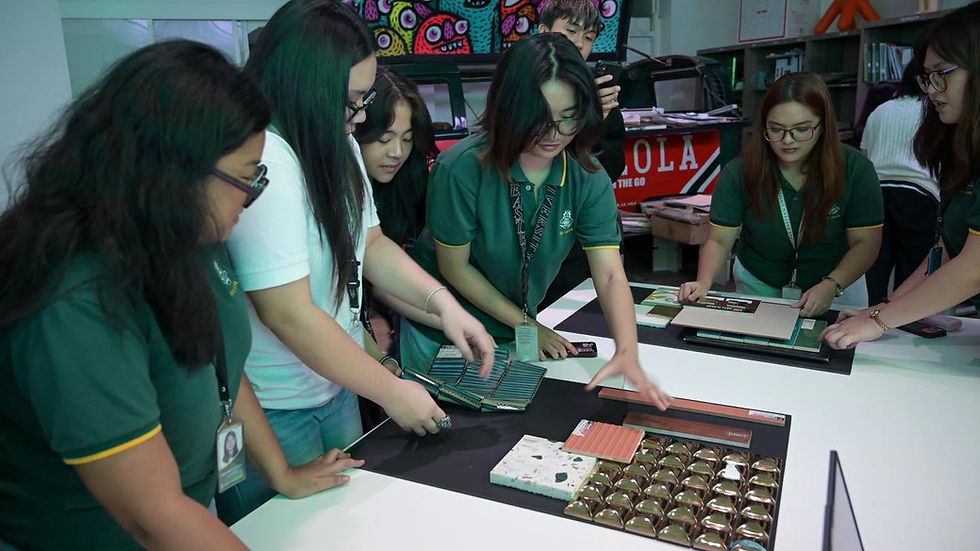
The next session took students out of the online discussion and into Headroom’s office last Oct. 1.
During the visit, Hilario observed how the architects worked. Although they had their own workstations and responsibilities, they regularly consulted one another, exchanged feedback, and discussed their outputs.
The collaborative environment stood out to him because it showed what teamwork looks like beyond a group requirement in school.
His professors had already introduced him to deadlines, project management, and workplace responsibilities. But seeing professionals work through their tasks together made those lessons easier to understand in a real setting.
“I realized that working in architecture goes far beyond designing buildings or spending the entire day in front of a computer using CAD, BIM, or modeling software,” he said.
The office also offered a glimpse of the culture surrounding the work. Hilario noticed activities such as heritage walks, theater screenings, sports events, and celebrations that brought employees together outside their project responsibilities.
These details changed how he viewed an architectural firm. There were deadlines to meet and outputs to finish, but there were also people working alongside one another, sharing ideas, and building a workplace community.
For students preparing for internships, this is another part of the transition to consider. Technical knowledge matters, but so does learning when to ask for feedback, how to communicate with colleagues, and how to contribute to a team.
By the end of the visit, the discussions from the first session had a clearer context. The work of an architect was not simply a series of drawings delivered on time. It involved coordination, relationships, and decisions that continued long after the initial design had been developed.
Putting a name to ideas
Last Oct. 6, the students were asked to bring together what they had learned by developing and presenting their own architectural firm concepts. Their proposals included company names and logos, areas of expertise, sample projects, and unique selling propositions explaining what would make their firms stand out.
For Hilario and his groupmates Joan'ella Basa, Rhise Alabado, and Cara Jane Antiporda, the result was Common Ground.
They began by asking one another why they had chosen architecture. Their answers were different, but a shared idea emerged: architecture could improve people's lives and strengthen the relationship between communities and the environment.
That belief became the foundation of their proposed firm. “Common” represented connection and inclusivity, while “Ground” referred to the site and context from which a design begins. They wanted their work to respond to the needs of people while respecting the natural environment.
Their concept went beyond creating functional spaces. They described architecture as a tool for connection and healing, calling themselves “doctors of the environment.”
Developing its identity and mission was not the most difficult part because the group shared similar values. Presenting it was another story.
Being the first group to present meant they had to introduce their ideas before seeing how the other groups would approach the task. Hilario recalled feeling nervous about the panel's response and whether or not their presentation would hold the audience's attention.
The group relied on one another and tried to communicate their proposal as clearly as possible. They also listened to the feedback from the industry speakers, including advice on maintaining eye contact instead of focusing too heavily on the slides.
For Hilario, that comment brought attention to a skill that can receive less focus when students spend much of their time developing designs.
“Even if an idea is well-developed, it may not be effectively understood if it is not presented clearly and confidently,” he said.
An architect must be able to explain not only what a design looks like, but also why certain decisions were made and what value the proposal offers. That conversation becomes particularly important when working with clients and other people involved in a project.
The experience also gave the group a chance to practice receiving criticism. Rather than treating the comments as a rejection of their work, they saw these as opportunities to refine their presentation and reconsider their approach.
Their proposal was hypothetical, but the exercise asked them to think through questions that real firms face: What do we stand for? What can we offer? How do we communicate that value to the people we hope to work with?
What students carry into profession
The three TamFLEX sessions followed a progression. Students first heard from industry professionals, then observed an architectural workplace, and finally applied their learning through their own firm concepts.
The series registered 34 participants. The sessions drew 54 students for the first online session, which was open to other interested individuals, 25 for the office tour, and 23 for the final session.
Through the partnership between FEU-IARFA and Headroom, the program gave students opportunities to explore aspects of architectural work that complement their formal design education, from client communication and professional responsibility to presentation and business development.
Hilario, now a senior hoping to graduate in 2028, left the experience with a clearer idea of what he wants to work on next. He hopes to improve his design efficiency, adapt to emerging CAD and BIM technologies, become more confident in presenting and defending his ideas, and learn more about contracts, client relations, and project management.
He does not see the experience as a sign that he is already prepared for everything the profession will demand. Rather, it helped him identify the areas where he still has room to grow.
His advice to fellow architecture students is to prepare for opportunities even before they arrive, remember that architecture extends beyond design, and learn to accept criticism.
These lessons are especially relevant while students are still building their portfolios and discovering their strengths. They may not yet be managing actual clients or running their own firms, but they can already practice communicating ideas, working with others, and taking feedback seriously.
Common Ground began as a classroom concept shaped by shared values. Presenting it gave Hilario and his team a chance to test how those values could be communicated as a professional identity.
All this made the experience meaningful: students were not only asked to imagine the work they wanted to produce as future architects. They were also asked to think about the responsibilities, relationships, and decisions that would come with it.
The drawings and models will remain an important part of their education. TamFLEX simply widened the picture, showing them more of what waits beyond the design.
Photo Credits: FEU Career Development and Placement Facebook Page


Comments