

Making space for every learner
For Abdul Haiy “Sir Bob” Sali, preparing future teachers means more than teaching them how to deliver lessons. It means helping them understand the learners behind those lessons and ensuring that different backgrounds, cultures, and experiences have a place in the classroom.
As a child, Sali attended Madrasah classes on weekends, as his parents had arranged. He learned to read Arabic text, but there was something he struggled with: understanding what he was reading.
It was an experience he would remember as he grew older and eventually entered the teaching profession.
“I am a product of Madrasah education,” he said. “I realized that there are a lot of things that I’ve learned in the institution. At the same time, I do have questions as well.”
Being able to read the text but having difficulty decoding or comprehending it made him wonder how Madrasah education was being implemented and what could be improved. Those questions eventually became part of his research, particularly on the experiences of Muslim Filipino learners and the place of Madrasah education in the Philippine education system.
For Sali, the subject was never entirely separate from his own life. He had experienced Madrasah education himself, and he wanted to understand it beyond his personal experience. As he began working in education, he became more interested in the gaps that researchers and policymakers had yet to address.
He believes Madrasah education remains understudied and undertheorized in the Philippines, where Muslim Filipinos make up a minority in a predominantly Christian society. His work has since focused on understanding how the system operates, how learners experience it, and how it can become more responsive to their needs.
“Being a teacher has always been a vocation,” he said. “And I thought that I am born to teach.”
Questions that followed him into the classroom
Before becoming a teacher, Sali was a registered nurse. He later became a licensed teacher, choosing a profession that would allow him to serve the country, share his talents, and work with learners.
One experience that helped shape his research came during his fellowship with Teach for the Philippines. He was assigned to Commonwealth Elementary School in Quezon City, where he encountered the Department of Education’s Madrasah Education Program, including Arabic Language and Islamic Values Education.
He noticed that Commonwealth had a dedicated building for its Madrasah education program. Not every school had the same arrangement, however, and implementation could be inconsistent in places outside communities with large Muslim populations.
That experience gave him a closer look at the differences between having an education program in place and ensuring that learners could actually benefit from it.
His first research study examined the implementation of Madrasah education in the Philippines. He said the study was later referenced by other researchers and used in policy formulation, something he considers a meaningful contribution to a field with relatively limited research.
His interest in the subject also grew through conversations with people who encouraged him to pursue it. Among them was Dr. Arlyne Marasigan of Philippine Normal University, who urged him to examine the gaps in Madrasah education. Marasigan later served on his thesis panel.
Sali recalled that around 2020, he found few recent publications that could help assess whether existing policies were being implemented effectively. He wanted to know more about how Muslim learners experienced education in different settings, from traditional Madrasah institutions to programs integrated into public schools.
The questions were not only about whether schools were available to learners. They were also about what kind of education learners received once they were there.
“We cannot fully understand education inclusion simply by asking whether learners have access to school,” he said.
In some isolated parts of Mindanao, he explained, Madrasah may be the only means through which children gain access to literacy and education. This makes the quality, relevance, and accessibility of Madrasah education an important concern, particularly for communities whose experiences are not always reflected in mainstream educational discussions.
For Sali, inclusion requires looking more closely at the circumstances in which learners live and learn. A policy may exist, but its value depends in part on how it is carried out and whether it responds to the people it is meant to serve.
More than religious instruction
One of the challenges Sali sees in conversations about Madrasah education is how narrowly it can be understood.
Madrasah is sometimes viewed mainly as a place for religious instruction, separate from the broader goals of education. Sali believes this misses its role in the lives of Muslim Filipino communities.
Madrasah education can contribute to identity formation, moral development, and the passing of knowledge and values from one generation to the next. It is also part of a larger conversation about how Muslim Filipinos are represented in education and in the country.
He believes that understanding these roles matters in a society where Muslims can still encounter stereotypes and misconceptions about their identity.
“We are Filipinos, regardless of our religious identity,” he said, emphasizing the place of Muslim Filipinos in the nation.
For him, Madrasah education should not be treated as an issue that concerns only Muslim communities or researchers who specialize in the subject. Its place in the education system also raises questions about how the country recognizes different communities and makes room for their experiences.
He sees the potential for Madrasah education to contribute to nation-building by making education more relevant to Muslim Filipino learners. Recognizing cultural and religious differences, in this sense, does not have to mean separating communities from one another. It can help people understand one another better.
This is also why he considers the work a continuing responsibility rather than a topic he can set aside after completing a study or receiving recognition.
“Having someone championing and advocating for Madrasah education, it’s always been a lifelong commitment,” he said.
He added that the work is not simply about having a specialization as an educator. It is about helping make education more inclusive for Muslim Filipino learners.
The decisions behind a curriculum
Much of Sali’s work is in curriculum development, a field whose effects are not always immediately visible to students, families, or the public.
A curriculum influences what teachers teach, what learners encounter in the classroom, and what schools choose to prioritize. For Sali, the work requires more than deciding which subjects or competencies should be included. It also means asking whose experiences and knowledge are represented in those decisions.
“Curriculum work may not always be visible to the public, but it can really influence what teachers teach, what learners experience, and what educational institutions prioritize,” he said.
That influence makes curriculum development particularly important when the needs of a community are not fully reflected in existing policies or teaching practices.
Madrasah education presents its own challenges because it is not a single, uniform system. Sali pointed to the diversity of Madrasah institutions, educational traditions, curricula, and institutional arrangements. Developing coherent learning outcomes while remaining responsive to Muslim learners' needs requires attention to these differences.
A curriculum that works in one setting may not automatically address the circumstances of another. The challenge is to make education relevant and appropriate without overlooking the varied experiences of the learners it serves.
For Sali, one question should remain part of the process: “Whose knowledge, experiences, identities, and aspirations do we want to reflect in the curriculum that we are developing?”
It is a question that reaches beyond Madrasah education. A curriculum communicates what a society considers important, including which histories, identities, and experiences deserve space in the classroom.
That question also connects his research to his work at Far Eastern University’s Institute of Education (IE). The students he teaches are preparing to become teachers themselves. The way they learn to think about curriculum, learners, and inclusion can influence the decisions they make when they eventually handle their own classes.
Sali hopes they will understand that teaching involves more than mastering a subject or learning how to deliver a lesson. It requires getting to know learners, examining assumptions, and being willing to improve one's practice.
Teachers need the knowledge and skills to teach effectively, he said, but they should also understand why their work matters and whom it serves.
The learner behind the lesson
Sali’s concerns about education also extend to a problem that teachers encounter in many classrooms: learners who struggle with basic literacy.
He recalled working with elementary pupils who had difficulty reading. When a learner cannot read or comprehend a text, more complex lessons can become harder to follow. The learner may struggle to keep up, even when the classroom moves on to new topics.
For him, basic literacy remains an enduring concern. It is difficult to talk about educational opportunities without considering whether learners have the skills and support they need to take part in their education.
These experiences have informed the kind of teacher educator he hopes to be. At FEU, he wants future teachers to recognize that classrooms bring together students with different backgrounds, languages, cultures, and experiences. Those differences should shape how teachers approach their work, rather than influence which learners receive the best opportunities.
“I hope they will remember that every learner deserves to be seen, heard, and given meaningful opportunity to succeed,” he said.
That means getting to know students instead of making assumptions about what they can do or what they need. It also means recognizing that teaching practices may need to change depending on the learners in the room.
The principle is straightforward, but putting it into practice takes attention and continued effort. Teachers must be willing to look beyond a lesson plan and consider whether students are actually learning, where they are having difficulty, and what might help them move forward.
Sali hopes FEU students will develop both competence and a strong sense of responsibility toward the people they teach. For him, preparing educators involves helping them understand not only how to teach, but also why their work matters to the learners who will depend on them.
An award, and the work that remains
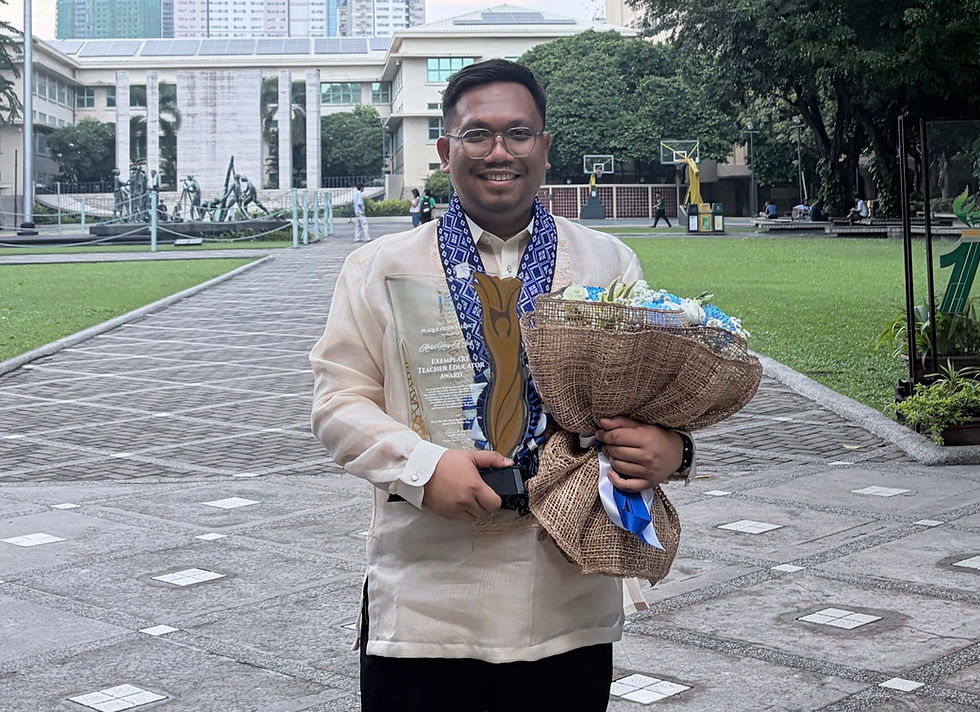
When Sali learned that he had been recognized as an Exemplary Teacher Educator by the Teacher Education Council, he was surprised.

He knew there were hundreds of applicants, many of whom were equally competent. At first, he thought being among the top 10 would already be a good outcome. After the interview, he learned that only three would receive the recognition.
The award became a personal affirmation of his decision to remain in teaching. It also reminded him of the communities he represents through his work.
Receiving it, he said, was meaningful not only as a professional achievement but also because it brought to mind Indigenous peoples and Muslims in the Philippines.
He also thought of his students. Their pride in their teacher became one of the things he remembered most about the recognition.
For Sali, the award is an affirmation of what he has contributed so far, but it does not mean the work is finished. He said there is still much to do, particularly in research, curriculum development, and efforts to make education policies and practices more responsive.
He hopes his work will continue to help future educators think carefully about the learners they will meet. Not every student will enter a classroom with the same opportunities, experiences, or level of preparation. Teachers cannot control every circumstance, but they can pay attention to what their students need and how their own decisions affect them.
His advice to future teachers is to take their influence seriously, even when they do not immediately see its effects.
“You never underestimate your impact as a teacher and what you can do,” he said.
He added, “You matter to your students more than they trust themselves.”
It is a reminder that a teacher’s influence may not always be obvious at the time. A lesson, a word of encouragement, or the decision to give a struggling learner another opportunity can matter in ways that are difficult to measure.
Sali is grateful to FEU for giving him opportunities to share his knowledge and teach future educators. He described being part of IE as a pleasure and expressed appreciation for the opportunities the university has given him.
His work in Madrasah education, meanwhile, remains tied to the questions that first emerged when he was a child attending weekend classes: what are learners experiencing, what might be missing, and how can education better serve them?
For Sali, those questions are still worth asking. They are part of the work of teaching, researching, and preparing the next generation of educators.
As he put it, “The true measure of teaching is what learners are able to become.”


Comments